How a septic system works, toilet to drain field
The tank, the drain field and the soil. What each part does and why the whole thing depends on all three.
If your house isn't connected to a city sewer line, everything that goes down your drains ends up in your own yard. That sounds worse than it is. A septic system is a small treatment plant, and most of it is dirt.
Knowing the parts makes every maintenance rule make sense, so here's the whole trip.
Step 1: the pipe out of the house
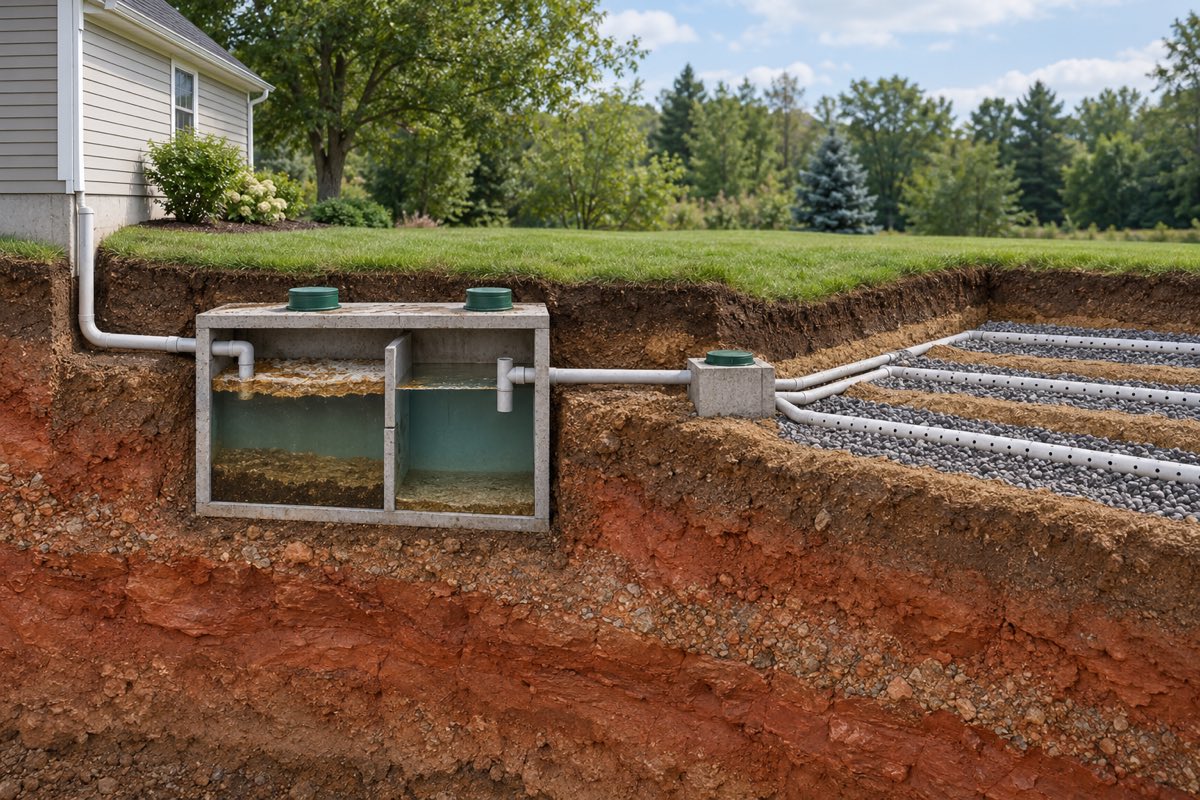
All the wastewater from toilets, showers, sinks and the washer leaves through one main drain pipe and runs into a buried tank. Clemson Extension notes that the pipe is usually 4 inches wide and the tank sits at least 5 feet from the house, a few inches to a few feet underground.
Step 2: the septic tank
The tank is a watertight, buried container. According to the EPA, its job is to hold wastewater long enough for the solids to separate. Heavy solids sink to the bottom and form sludge. Grease and lighter solids float to the top as scum. The liquid in the middle, called effluent, is the only part that leaves the tank.
Bacteria already living in the tank go to work on the solids. Virginia Cooperative Extension says they can convert up to half of the solids into liquids and gases. The other half stays, which is why a tank needs pumping on a schedule.
Two fittings at the ends of the tank matter more than they look. The inlet and outlet tees, often called baffles, slow the water down and keep scum from drifting out. SC DES lists broken or missing tees and baffles as a common cause of system failure.
Step 3: the distribution box and drain field
From the tank, effluent runs to the drain field, also called the drainfield or leach field. In a conventional system the EPA describes it as shallow trenches filled with stone or gravel, covered with fabric and then soil. In many systems the effluent first passes through a distribution box, which splits the flow evenly among the trenches. A box that isn't splitting evenly is one of the things an inspector checks.
Step 4: the soil does the final cleanup
This is the part people forget. The effluent trickles down through the gravel into the native soil, and microbes in the soil treat it further before it reaches groundwater. The EPA says the soil removes harmful bacteria, viruses and some nutrients.
The drain field is a filter, and it only works if the soil underneath can take the water and has air in it. SC DES points out that the bacteria in the drain field need oxygen, which is why packed-down soil is a problem. For more, see drain field mistakes, ranked.
Why bedrooms set the size
In South Carolina, the system is sized by the number of bedrooms, not by how many people live there now. SC DES assumes that each bedroom could be shared by two people, who together produce about 120 gallons of wastewater a day. A three-bedroom house is sized for about 360 gallons a day.
That's why SC DES warns owners not to underestimate bedrooms when applying for a permit, and why a home turned into a rental that sleeps far more people than it was designed for is prone to failure, as SC DES puts it.
Soil decides what kind of system you get
SC DES inspectors look at soil color, which shows how high the water table gets in the wettest part of the year, and soil texture, which shows how fast water moves and how well the soil treats wastewater. Soil with a lot of clay needs a much larger drain field than sandy soil does. In the Upstate that matters, and the Piedmont clay post covers it.
When a lot can't support a conventional system, there are other designs. SC DES describes alternative systems that use sand, peat or plastic to treat wastewater, and some use pumps, aerators or float switches. Those systems need more frequent and more careful maintenance. Clemson says mechanical systems need an inspection every year, and the EPA says the same for alternative systems.
What this means for you
A few habits follow directly from how the parts work:
- Pump the tank on schedule so solids stay in the tank and out of the field.
- Keep wipes, grease, chemicals and other non-waste out, because they clog the field or kill the bacteria. See what not to flush.
- Spread water use over the week so the field isn't flooded.
- Keep cars off the tank and the field.
- Keep records and a map so a contractor can find everything fast.
A septic system lasts a long time when it's looked after. The EPA gives an average lifespan of 15 to 40 years, and Clemson says 20 to 30 years with good maintenance.